
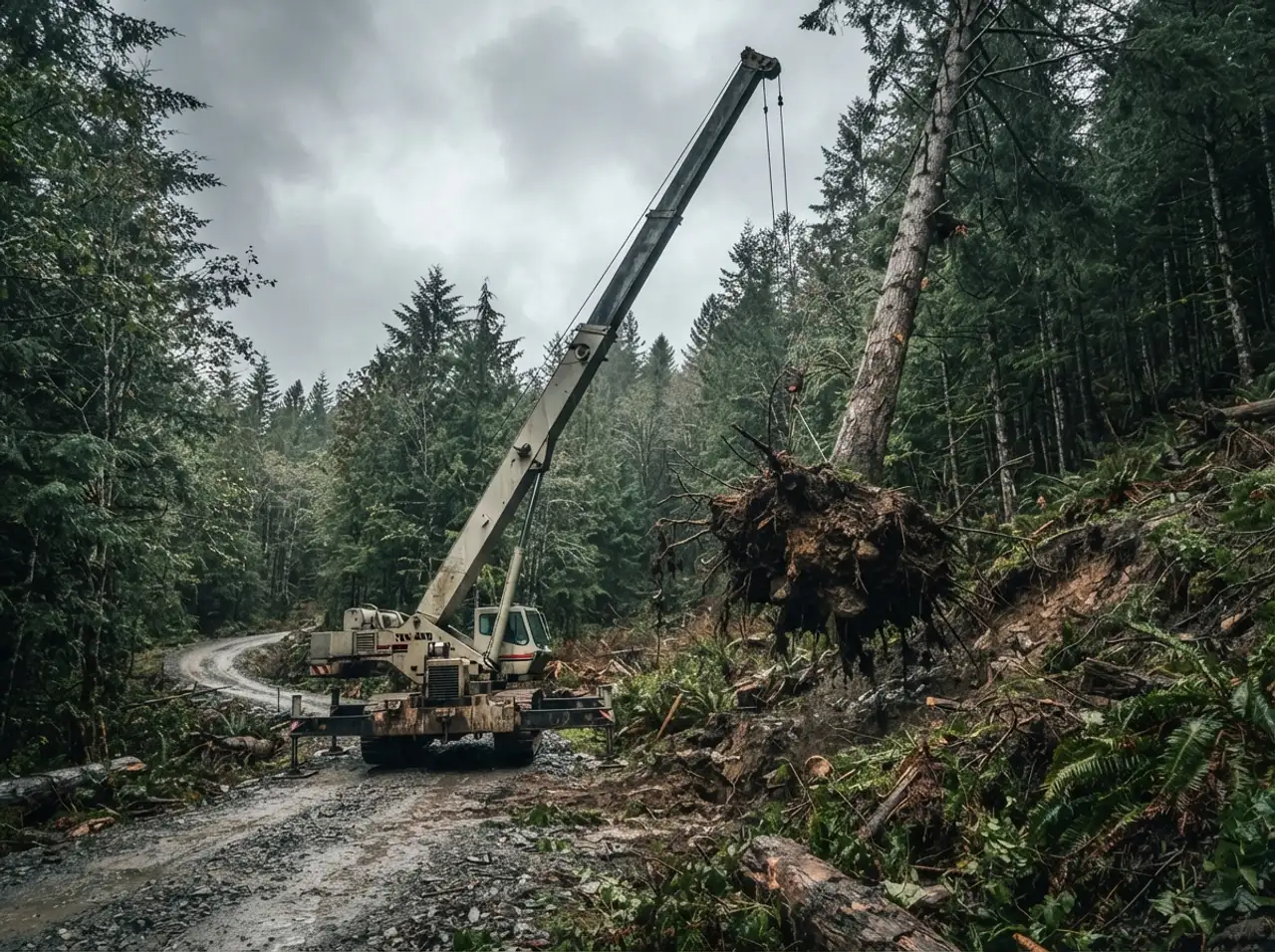
01 / Disaster-Driven Risk Mitigation
After the fire, the storm, or the wind, the trees left standing are the problem.
Post-disaster hazard tree removal after fire, tornado, hurricane and windstorm on federal land, with 24-hour emergency mobilization delivered under our NCA BPA, against a 48-hour contractual standard.
The trees standard crews decline
After a fire, storm, or wind event, the trees that fail first are the obvious ones. The trees that fail next are the ones that survived but are now compromised: root plates lifted, trunks cracked, crowns hung up in adjacent canopy. Standard crews walk away from those because the risk of removing them exceeds the risk of leaving them. We take them.
A post-fire snag is not a standing tree. It is a vertical fuel column with a compromised root system, and it will come down on its own schedule. The question on a post-disaster site is not whether the tree fails. It is whether it fails on our terms or its own. We make it fail on ours.
What We Deliver
Six post-disaster hazard tree removal capabilities that hold on a post-event site
Post-event job hazard assessment
Before any saw starts, we read every compromised tree on the site. Root plate lift, canopy hang, and partial failure get documented against what is standing below them. The assessment drives the rigging plan and determines the order of removal, the method, and the exclusion zone around each tree.
TRAQ risk assessment on post-event sites
Formal ISA Tree Risk Assessment Qualified evaluation identifies the target, the likelihood of failure, and the consequence of impact. That rating determines whether we remove or monitor, and it goes into the project record.
Crane-assisted extraction over occupied structures
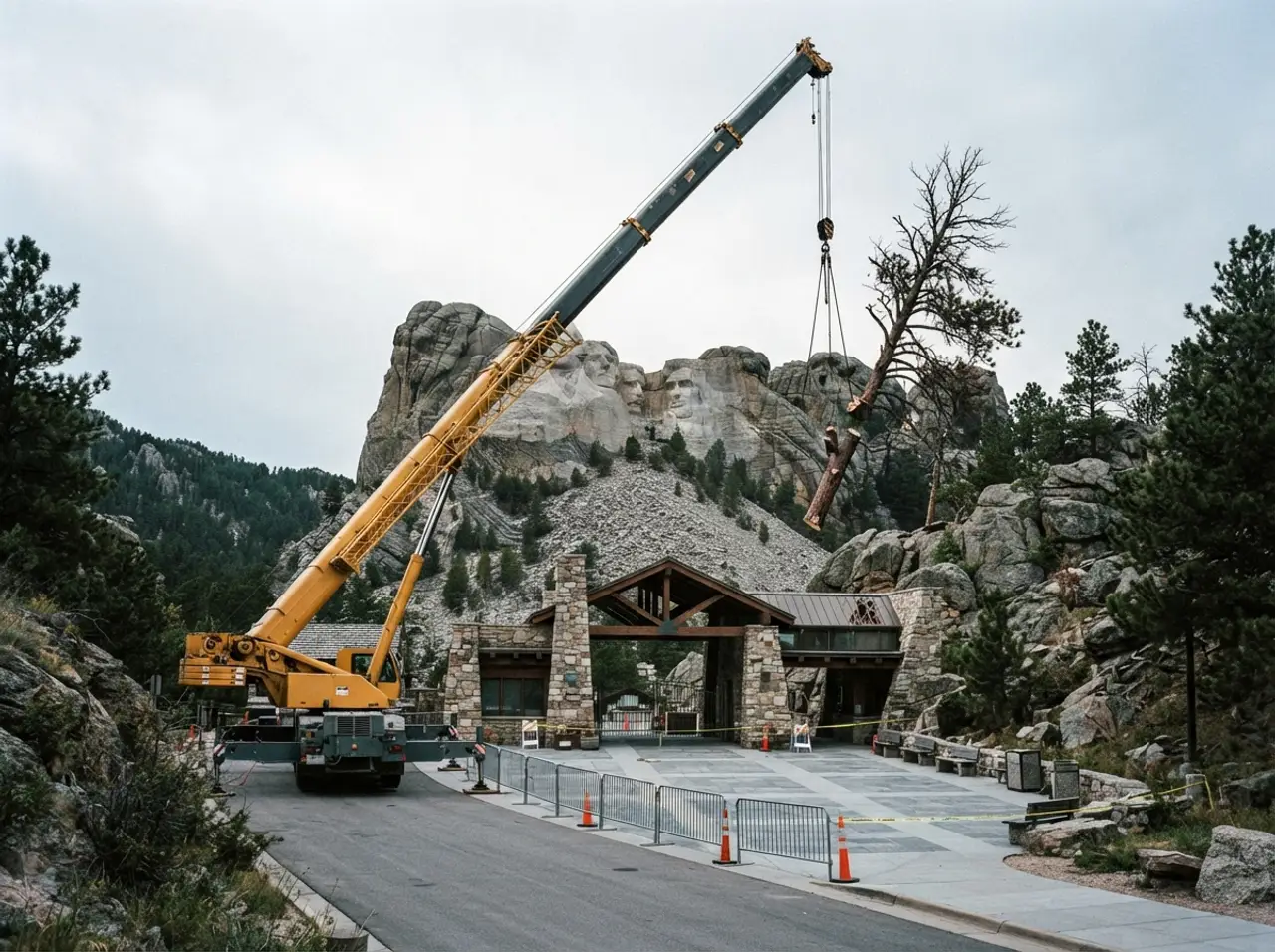
When a compromised tree leans over a visitor center, a roadway, or a historic structure, we bring a crane. The tree comes out in rigged pieces, each one controlled from the lift to the ground. Nothing drops. Nothing falls free.
Compressed-window scheduling
Post-event work happens inside the window the agency can give us, which is often measured in hours. We stage crews and equipment so the removal fits the closure, not the other way around. If the site reopens at noon, we are clear by noon.
Debris and slash removal
The tree on the ground is not the end of the job. We process slash, chip brush, and remove woody debris so the site is clear for visitors and operations. Post-event debris is heavier and more variable than routine removal debris.
24-hour emergency mobilization
Federal emergency calls do not wait for business hours. Our crews and equipment are staged to reach federal land within 24 hours of the call, against a 48-hour contractual standard. The work has to start before the next failure event, because on a post-disaster site, the next failure event is already in motion.
The Hardest Problem in This Lane
Montezuma Castle and Tuzigoot National Monuments
This was a follow-on to the 2023 Tuzigoot Fire. TRAQ assessment identified $1M+ in federal infrastructure at imminent risk. Six critical trees, approximately 36-inch DBH, were removed by crane over the occupied visitor entrance, plus 48 additional trees mitigated. A Biomonitor was on site for endangered species compliance.
We extracted 108,000 lbs by crane inside a 12-hour closure window. The site draws 850,000 annual visitors, all protected. Zero damage. Completed in under 5 days.
Where This Applies
Federal land where post-event mitigation is required
National Monuments
Montezuma Castle and Tuzigoot National Monuments, AZ, following the 2023 Tuzigoot Fire.
National Recreation Areas
Chickasaw National Recreation Area, OK, following the April 2024 EF3 tornado.
National Cemeteries
Four national cemeteries in California and Oregon under the NCA Pacific District BPA, with 24-hour storm-damage emergency response.
Next Step
When the next event hits, we are already moving
Download the capability statement for post-event hazard mitigation on federal land. The full capability statement, past performance summary, and federal registration data are available as a single document. For teaming opportunities, see how we work with partners.
Federal Registration
Ready to mobilize
| Field | Value |
|---|---|
| UEI | GZ3XMZPPKA59 |
| CAGE | 9NKZ6 |
| Primary NAICS | 561730 |
| Additional NAICS | 115310 and 113310 |
| PSC | F014 S208 F018 |
| SAM.gov Status | Active |
The Arborist is a Service-Disabled Veteran-Owned Small Business serving federally managed land across the United States.